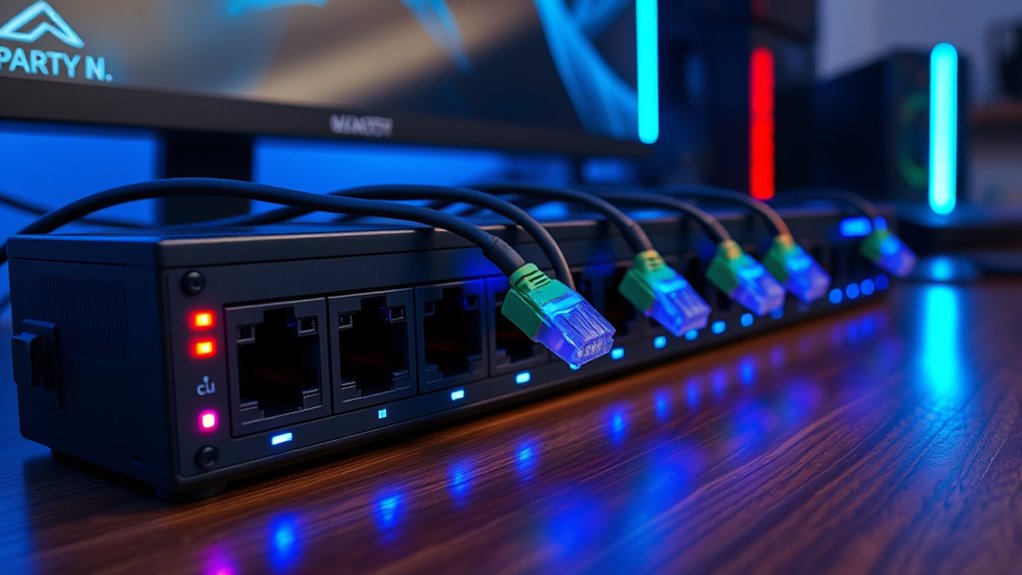
Is a Gigabit Ethernet Switch Essential for Your Gaming Rig? Unlocking Peak Performance
For serious gamers, every millisecond counts. Whether you're dominating in a fast-paced FPS, navigating intricate worlds in an MMORPG, or streaming your gameplay to a global audience, your network connection is a critical component of your gaming setup. While much attention is often paid to internet speeds, the performance of your *local* network infrastructure is just as vital. This brings us to a crucial question: is a gigabit ethernet switch gaming essential for your gaming rig? Let's dive into the world of wired networking and discover how this seemingly simple device can profoundly impact your gaming experience.What is a Gigabit Ethernet Switch and How Does It Benefit Gaming?
At its core, Gigabit Ethernet is a wired networking standard that supports blazing-fast speeds of up to 1 gigabit per second (Gbps), or 1000 megabits per second (Mbps). This makes it approximately ten times faster than older Fast Ethernet standards and significantly more stable than most Wi-Fi connections in real-world scenarios. A Gigabit Ethernet switch is a device that allows multiple wired devices, such as your gaming PC, console, smart TV, or network-attached storage (NAS), to connect to your home network, all operating at these high speeds. Here's why a gigabit ethernet switch is a game-changer for your gaming rig:- Dedicated 1 Gbps Links: Unlike Wi-Fi where bandwidth is shared and prone to fluctuations, each port on a Gigabit Ethernet switch provides a dedicated, full 1 Gbps link to the connected device. This means your gaming PC isn't competing for bandwidth with a family member streaming 4K video in another room or someone downloading large files. Each device gets its own express lane, ensuring consistent performance for your gaming.
- Unwavering Stability and Consistency: For online gaming, stability is king. A wired Gigabit Ethernet connection eliminates the unpredictable drops, interference, and signal degradation common with Wi-Fi. This translates to fewer frustrating disconnections, less rubber-banding, and a smoother, more reliable online experience.
- Crucially Low Latency: Perhaps the most significant advantage for gamers is reduced latency, often referred to as "ping." Latency is the delay between your input (e.g., clicking a mouse, pressing a button) and the game server receiving that action. Gigabit Ethernet significantly lowers this delay, offering a more responsive connection that can give you a competitive edge. When every millisecond matters, a wired connection provides the lowest and most consistent ping possible within your home network.
Gigabit Ethernet vs. Wi-Fi: The Gamer's Edge
While modern Wi-Fi standards like Wi-Fi 6 (802.11ax) boast impressive theoretical speeds, the reality for gamers often falls short. Wi-Fi's bandwidth is shared among all connected devices, and its performance can be severely hampered by a multitude of factors, including:- Physical Obstructions: Walls, furniture, and even certain building materials can degrade Wi-Fi signals.
- Interference: Other wireless devices, microwaves, Bluetooth devices, and even neighboring Wi-Fi networks can cause interference and lead to dropped connections or reduced speeds.
- Distance and Congestion: The further you are from your router, the weaker the signal. Additionally, crowded airwaves in dense residential areas can lead to significant slowdowns.
Beyond Internet Speed: The Local Network Advantage
Many gamers wonder if a Gigabit Ethernet switch is truly beneficial if their internet service provider (ISP) doesn't offer a full 1 Gbps internet plan. This is a common and important distinction to make. While "Gigabit Internet" refers to the speed of your connection *to the outside world* provided by your ISP, "Gigabit Ethernet" refers to the speed and capability of your *local home network*. Even if your internet plan is 100 Mbps, 300 Mbps, or 500 Mbps, a Gigabit Ethernet switch still offers significant advantages within your home:- Optimized Internal Transfers: If you frequently transfer large game files between your gaming PC and a network-attached storage (NAS) device for backups, stream games from your PC to another device like a smart TV via Steam Link, or access media from a local server, a Gigabit Ethernet switch ensures these internal transfers happen at maximum speed (up to 1000 Mbps). This dramatically reduces waiting times compared to a slower local network.
- Eliminating Internal Bottlenecks: In a modern, "ultra-connected home," multiple devices are constantly vying for network resources. You might have one family member streaming 4K Netflix, another video conferencing for work, and you trying to game online. Even if your internet connection can handle all this simultaneously, a slower local network (e.g., using older Fast Ethernet or congested Wi-Fi) can create internal bottlenecks, slowing down devices even before they hit your internet connection. A Gigabit switch ensures your local network traffic flows freely and efficiently.
- Future-Proofing Your Setup: As internet speeds continue to increase and game files grow larger, investing in a Gigabit Ethernet switch now prepares your network for future demands. When you eventually upgrade to a faster internet plan, your internal network will already be ready to handle it without requiring further hardware changes.
While gaming itself doesn't always demand extremely high *bandwidth* (the FCC's minimum for broadband is 100 Mbps, and 25 Mbps is sufficient for 4K streaming per device), it critically relies on *low and stable latency*. A Gigabit Ethernet switch ensures your gaming rig consistently receives that optimal low-latency connection from your router, irrespective of your ISP's speed, provided it's at least 100 Mbps or more.
Is It Essential for Your Gaming Rig? Practical Advice
So, is a Gigabit Ethernet switch truly *essential* for your gaming rig? The answer is nuanced, but for any serious gamer, the benefits make it an undeniable recommendation, often bordering on essential for an optimal experience. You absolutely need a Gigabit Ethernet switch if:- You're a competitive gamer: Every millisecond of latency and every dropped packet can mean the difference between victory and defeat. A wired Gigabit connection provides the most reliable foundation.
- You stream your gameplay: Stable upload speeds are crucial for maintaining a high-quality stream without stuttering or disconnects.
- You share your home network: If other household members stream 4K content, download large files, or use video conferencing, a Gigabit switch ensures their activities don't degrade your gaming performance.
- You frequently download large games or updates: While limited by your internet speed, a robust internal network ensures maximum utilization of that speed.
- You use local network features: If you have a NAS, media server, or stream games between local devices, a Gigabit switch is indispensable for fast transfers.
- You simply want the best, most reliable connection possible: If you seek peace of mind and want to eliminate network as a variable in your gaming performance, wired Gigabit Ethernet is the way to go.
- Check Your Router: Most modern routers come with built-in Gigabit Ethernet ports (often 4 of them). If you only need to connect one or two devices directly to your router, you might not need an additional switch.
- Expand Your Ports: If your router's ports are full, or if you need to connect multiple wired devices in a location away from the router (e.g., in your gaming den), an external Gigabit switch is the perfect solution. They are typically plug-and-play and require minimal setup.
- Use Proper Cabling: Ensure you're using Cat5e, Cat6, or higher-rated Ethernet cables. Older Cat5 cables might not support full Gigabit speeds over longer distances.
- Location Matters: While wired connections are less susceptible to interference, ensuring your switch and router are in well-ventilated areas can help with longevity.
- Run a Speed Test: Before and after setting up your wired connection, run an online speed test (e.g., Speedtest.net) to measure your actual internet speeds and compare them to your Wi-Fi performance. Pay close attention to the ping/latency numbers.